Ramp agent jobs and ground handling jobs form the operational backbone of every airport in the world. While passengers see the terminal, the check-in desks, and the aircraft, a large team of professionals works on the airfield, known as the ramp or apron, to make sure each flight is loaded, serviced, fuelled, cleaned, and dispatched safely and on time.
If you are searching for airport jobs, airline jobs for freshers, or aviation careers that do not demand a university degree, becoming a ramp agent or ground handling staff member is one of the most practical ways to enter the industry.
As global air travel expands, airports are adding terminals, airlines are growing their fleets, and ground handling companies are recruiting in large numbers. Every aircraft that lands needs a coordinated turnaround involving baggage loading, cargo handling, pushback, marshalling, and safety checks.
This guide explains what ramp agents do, the different ground handling roles, eligibility criteria, ramp agent salary, the best ground handling courses, safety rules, and practical steps to apply for ramp agent jobs and build a long-term aviation career.
What Is Ground Handling?
Ground handling refers to all the services an airline needs at an airport, apart from air traffic control. These services include passenger handling, baggage handling, ramp operations, aircraft loading and unloading, aircraft servicing, fuelling, catering, cleaning, de-icing, cargo handling and aircraft towing.
Ground handling is provided by airlines themselves (self-handling), by airport operators or, very commonly, by specialist ground handling service providers (GHSPs) that serve multiple airlines under contract.
Ramp handling is the part of ground handling that takes place on the airside, near the aircraft. It covers everything from receiving an arriving aircraft and positioning chocks and cones, to unloading baggage and cargo, loading the departing flight, connecting ground power, and finally pushing the aircraft back from the stand. Because the ramp is an active, high-risk environment, ramp staff must follow strict safety procedures and work with precise coordination.
What Does a Ramp Agent Do?
A ramp agent is responsible for the safe and efficient handling of aircraft, baggage, and cargo during turnaround. When an aircraft arrives, ramp staff guide it into position, place wheel chocks and safety cones, and connect ground support equipment such as ground power units and air-conditioning. They then open the cargo holds and unload baggage, mail, and freight using belt loaders, baggage carts, and tractors.
For departing flights, the ramp team loads baggage and cargo according to the load plan prepared by the load controller. Correct placement is vital, since weight and balance directly affect flight safety.
Ramp agents also assist with aircraft marshalling, headset communication during pushback, and the removal of equipment before departure. They inspect the aircraft exterior for visible damage, report any irregularities, and ensure that no foreign objects are left on the apron, because even a small item can cause serious engine damage.
The work is fast-paced and physical, often performed in heat, rain, cold, and noise. Teamwork, timing and discipline are essential, because airlines are judged on on-time performance, and a delay of a few minutes in loading can affect the whole schedule.
Types of Ground Handling Jobs
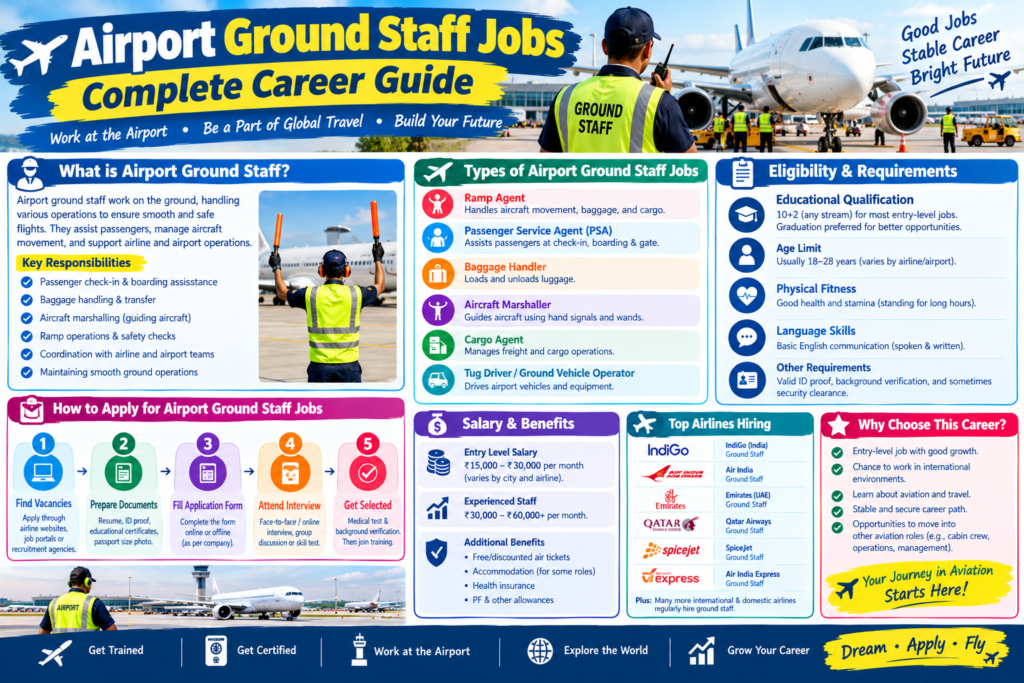
The ground handling sector offers many positions. Ramp agents and baggage handlers load and unload aircraft. Ramp supervisors and ramp team leaders manage crews, assign tasks, and ensure compliance with safety rules. Ground support equipment (GSE) operators drive and operate vehicles such as tow tractors, pushback tugs, belt loaders, container loaders, catering trucks and fuel bowsers.
Aircraft marshallers guide aircraft to and from stands using hand signals or lighted wands. Pushback operators tow the aircraft away from the gate. Cargo handlers work in cargo terminals, sorting, scanning and loading freight.
Load control and weight and balance staff prepare load sheets and coordinate with pilots. Aircraft cleaners, lavatory and water service staff and catering loaders prepare the cabin for the next flight. Fuelling agents supervise safe refuelling operations, and de-icing operators work in cold regions to remove ice and snow.
Many people start as general ramp agents and later specialise in equipment operation, supervision, load control, or operations management, which offer higher salaries and improved working conditions.
Eligibility Criteria for Ramp Agent Jobs
The eligibility criteria for ramp agent jobs are generally simpler than for many other aviation roles. Most employers require candidates to have passed 10th or 12th grade, although some positions prefer a diploma in aviation, logistics, or a technical trade.
Graduates may apply for supervisory or operations roles. A basic understanding of English and the local language is important for following instructions, safety notices and radio communication.
Age requirements commonly range from 18 to 30 years for entry-level positions. Candidates must be physically fit, as the job involves lifting baggage, standing for long hours and working outdoors in all weather.
A medical fitness certificate is typically required, and good eyesight, hearing, and colour vision are important for safety on the ramp. For roles involving vehicle operation, a valid driving licence is essential, and an airside driving permit is issued after passing the airport’s training and test.
Because airports are secure zones, applicants must pass a police verification and background check to obtain an airport entry permit (AEP) or security pass. A clean record, reliability and a responsible attitude are therefore very important. Prior experience in logistics, warehousing, courier services, or manual handling can be an advantage, but most employers provide on-the-job training to freshers.
Best Ground Handling Courses and Training
Although many companies hire and train freshers, completing a relevant ground handling course can improve your chances of selection and help you advance faster. Popular options include a diploma in aviation ground handling, airport operations management courses, the IATA Airport Ground Handling course, aviation safety and security training, and dangerous goods regulations (DGR) certification. Courses in airport ramp safety, aircraft marshalling, load control, and air cargo handling are also valuable.
IATA training programmes are widely respected because the International Air Transport Association sets many global standards, including the IATA Airport Handling Manual (AHM).
Completing recognised certifications shows that you understand international safety and operational standards. For equipment operators, training in GSE operation and airside driving is mandatory, and it is usually provided by the employer or airport authority.
When choosing an aviation training institute, verify its approvals, instructor experience, practical training facilities, and placement record. Avoid institutions that promise guaranteed jobs or charge hidden fees. Good training teaches not only technical skills but also ramp safety, communication, teamwork, and emergency response, which are essential for working near aircraft.
Ramp Safety: The Most Important Part of the Job
Safety is the priority in ramp operations. The apron contains moving aircraft, vehicles, fuel, jet blast, propeller hazards, and heavy equipment, so even a small mistake can cause injury or damage costing millions. All ramp staff receive training in ramp safety, personal protective equipment (PPE), and foreign object debris (FOD) prevention.
Standard safety practices include wearing high-visibility vests, ear protection, safety shoes and gloves; staying clear of engines and propellers; following designated walkways; obeying speed limits and signs; using chocks and cones correctly; and communicating clearly with team members through hand signals or radios.
Ramp agents must never approach an aircraft until the anti-collision beacon is off and the engines are shut down, and they must follow strict rules around fuelling, such as avoiding ignition sources.
Another critical issue is aircraft damage prevention. Ground equipment striking an aircraft is a leading cause of costly incidents, so staff are trained to position vehicles carefully and report any contact immediately, no matter how minor.
Companies that maintain strong safety cultures usually follow international programmes such as IATA Safety Audit for Ground Operations (ISAGO), and working for such organisations offers valuable credentials for your career.
Ramp Agent Salary and Benefits
Ramp agent salary depends on the employer, airport, location, shift schedule, and experience. In India, entry-level ramp and baggage handlers usually start with a modest monthly pay, but allowances for night shifts, overtime and festival duties can raise take-home earnings.
Skilled positions such as GSE operator, pushback driver, ramp supervisor and load controller earn noticeably more, and senior managers in ground operations earn even higher salaries.
Ground handling jobs overseas, particularly in the Gulf region, Europe, Canada, Australia and parts of Southeast Asia, often provide higher pay, overtime opportunities, accommodation or housing allowances and annual leave tickets. In some countries, ramp agent roles at major airlines offer competitive wages and strong benefits.
Typical ground staff benefits include medical insurance, provident fund or pension, paid leave, uniforms and safety gear, meal or transport allowances and performance bonuses. Employees of airlines often receive discounted or free staff travel tickets, which many consider a major perk. As you gain experience, certifications, and supervisory responsibility, your income grows steadily, making this a stable career for those who work consistently and safely.
How to Apply for Ramp Agent and Ground Handling Jobs
To apply for ramp agent jobs, start by identifying the airlines, airport operators, and ground handling companies at airports near you. Check their official career pages regularly and follow verified social media accounts for recruitment announcements. Many companies also run walk-in interviews and large recruitment drives when new airports, airlines, or routes open, so keep your documents ready.
Prepare a simple, professional resume that lists your education, any certifications, physical fitness, driving licence, languages, and relevant experience. Include accurate contact information and a recent photograph.
Gather required documents such as identity proof, address proof, educational certificates, medical fitness certificate, and police verification details. Online job portals and aviation recruitment platforms are also useful sources of openings.
Always apply through official channels. Never pay money to agents who promise guaranteed ramp or airport jobs, because genuine employers do not charge recruitment fees. Verify any offer through the company’s official website or HR contact before sharing personal documents or making any payment.
The Selection and Interview Process
The selection process for ground handling staff usually includes several steps. After resume screening, candidates may take a written test covering basic English, arithmetic and general awareness, followed by a physical fitness test that checks strength, stamina, and ability to lift baggage. A personal interview evaluates attitude, reliability and understanding of the role. For equipment operator positions, a practical driving test may be required.
Interview questions often explore why you want to work on the ramp, how you handle physically demanding work, how you would respond to a safety violation by a colleague and whether you are comfortable working night shifts and holidays.
Employers want reliable people who take safety seriously, follow instructions and work well in teams. Give honest answers, highlight any experience with teamwork or physical labour, and demonstrate a responsible attitude.
After selection, candidates undergo medical checks, background verification and security clearance. New employees then receive induction training that covers airport layout, airside safety, emergency procedures, equipment operation and company policies, followed by supervised on-the-job training before working independently.
Skills Required to Succeed as a Ramp Agent
Success in ramp agent careers depends on a mixture of physical, technical, and personal skills. Physical fitness and stamina are essential for lifting bags, working long shifts and handling various weather conditions.
Safety awareness is the most critical skill, since the ramp requires constant vigilance. Teamwork and communication help crews coordinate during rapid turnarounds, especially when using hand signals or radios in noisy conditions.
Attention to detail ensures that baggage is loaded in the right compartments, tags are checked and loading instructions are followed accurately. Equipment operators need good hand-eye coordination, spatial judgement, and responsible driving habits.
Time management and the ability to stay calm under pressure are vital, because delays, weather problems, and sudden schedule changes are common. Finally, a positive attitude, punctuality and discipline help you earn trust and move up to supervisory roles.
Advantages and Challenges of Ground Handling Careers
The advantages of ground handling jobs are significant. Entry requirements are modest, training is provided, and demand is steady because airports operate around the clock. You become part of the aviation industry, gain hands-on experience with aircraft, and can progress to supervisory, technical, or management positions. Many employers provide staff travel benefits, structured training and job security, especially with major airlines and established handling companies.
The job also has challenges. Ramp work is physically demanding and often performed outdoors in extreme heat, cold, rain, and noise. Shifts rotate through nights, weekends, and holidays, which can affect family life and sleep.
The environment carries safety risks, and mistakes can have serious consequences, so constant attention and adherence to procedures are required. However, with proper training, protective equipment, and a safety-first mindset, these risks are managed effectively, and many people enjoy long, successful careers.
Career Growth and Future Prospects
A ramp agent can build a strong career path. After gaining experience, you can become a senior ramp agent, team leader, ramp supervisor, and duty manager. With additional training, you may move into load control, ramp operations coordination, safety and quality assurance, airside operations, or station management. Those who earn certifications in dangerous goods, GSE maintenance, or aviation safety can also work as trainers or auditors.
The future outlook is positive. Passenger numbers and air cargo volumes are rising, and e-commerce is driving demand for air cargo handling services. Airports are investing in automation, such as electric ground support equipment, digital baggage tracking, and automated loading systems, which will change how work is done.
Workers who adapt by learning new technologies, maintaining safety certifications, and developing leadership skills will remain highly employable. Continuous learning is the key to long-term growth in this field.
Tips to Get Hired Faster
Begin by improving your fitness, since many employers test physical ability. Learn basic English and aviation terms, and practise reading simple instructions. If possible, obtain a driving licence, since equipment operators are in high demand. Consider completing a short ground handling course or airport safety certification to show commitment and strengthen your resume.
Keep your documents ready and updated, apply to multiple employers, and be willing to work in shifts. Stay informed about hiring events at nearby airports and join aviation communities to learn about openings.
During interviews, emphasise reliability, safety awareness and teamwork. Be patient and persistent, as competition can be strong, and always avoid fraudulent job offers by verifying every opportunity directly with the employer.
Conclusion
Ramp agent jobs and ground handling careers provide an accessible, stable, and rewarding entry into the aviation industry. With modest entry requirements, on-the-job training and clear progression paths, they suit freshers and anyone who enjoys active, team-based work. By meeting the eligibility criteria, prioritising ramp safety, completing relevant ground handling courses, applying through genuine channels, and continuously building your skills, you can grow from an entry-level ramp agent into a supervisor, operations manager or aviation safety professional. For those willing to work hard and stay disciplined, the airport ramp can be the starting point of a long and successful aviation career.